Introduction
Everyone knows Nepal for two things: Everest and trekking poles. Ask most travelers what they imagine when they think of Nepal, and you’ll likely hear something about a group of people in down jackets, single file, hiking up a stone staircase towards Base Camp. Fewer people would describe a muddied biker flying down a single track switchback, the path carved into the mountainside at 4,000 meters, with the glow of a golden monastery at his back – but this rider, and this trail, and this view, all exist. They are, in fact, a part of Nepal, and a large part of the adventure travel niche, for those who know where to look.
Mountain biking in Nepal is not a subset of trekking with two wheels attached. It is its own unique niche, with its own culture, its own network of trails, and its own dirtbag fanatics who have quietly explored and cataloged the old salt-trading routes, herder trails, and monsoon-washed goat paths for two decades. This is a guide for the subset of the subset – for the traveler who has already done their research on the top 10 treks, but who wants a guide written by people who actually clip into pedals
Why Nepal is a Mountain Biker’s Fever Dream?
Nepal’s geography is a mountain biker’s wet dream in ways that few other countries can claim. Within a short distance, you can ride from subtropical jungles to high desert plateaus, with rice paddies, pine forests, and rhododendron cloud forests in between. The Annapurna Circuit, one of the country’s most famous biking routes, has a distance of around 200 km and offers up mountain vistas from 6,000 to 8,000 meters – and that’s just the altitude gain. As you ride the high trail, you’ll pass from one climate zone to another, encountering everything from jungle to alpine tundra in a single day.
What makes these trails so special, aside from the scenery, is the network of paths carved into the mountains by centuries of trade, herding, and pilgrimage. These trails, used by foot and pack animals for centuries, provide mountain bikers with malleable terrain that ranges from smooth dirt roads to technical scree and rocky riverbeds. The trails are generally wide enough and not too steep for a mountain bike, but far too narrow and technical for a car, making them uniquely accessible to two-wheeled adventurers. Trekking routes tend to stick to more well-trodden paths and avoid steep ascents and descents, while bikers have the opportunity to carve their own way up and down the mountain. While a trekking group might see one or two valleys in a day’s hike, a rider can see three – or more.
Before You Clip In: Permits, Seasons, and Logistics
Nepal is not a country where you can just show up and ride, and the ignorance of that fact is what leads to so many frustrated riders turned away at trailheads 40 km into a 5-day route. A little research can save you a lot of heartache, so here’s a crash course in the permits, seasons, and logistics that every mountain biker needs to know before arriving in Nepal.
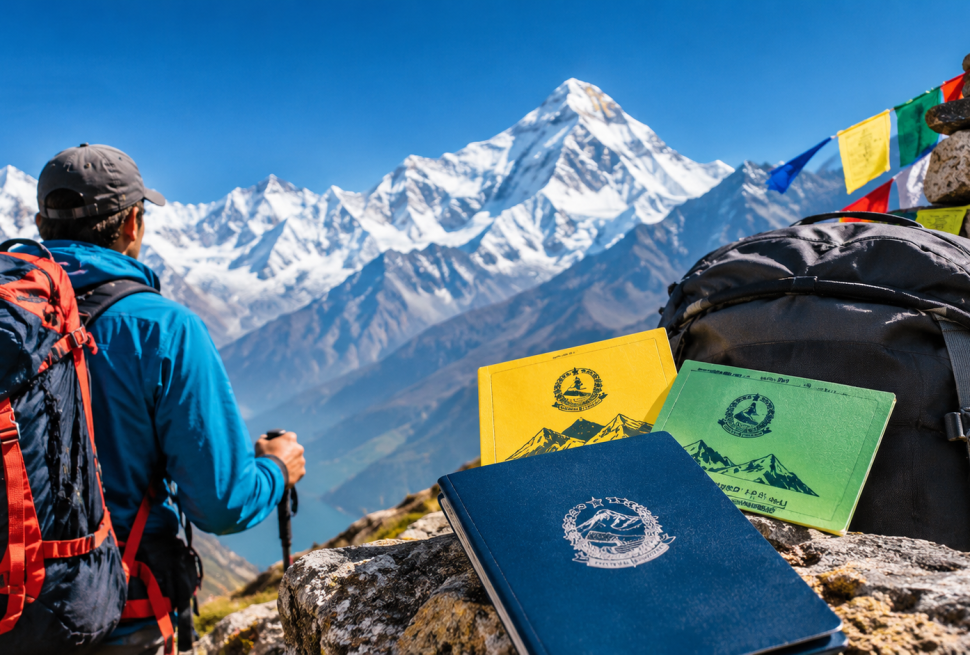
Permits. Many of the trails that make up the core of mountain biking in Nepal are found in conservation areas and require some form of permit to enter. The most common permits are the TIMS card, restricted area permits for places like Manaslu and Upper Mustang, and conservation or national park permits like the ACAP permit for the Annapurna region. Restricted area permits tend to be the most expensive, with costs ranging from roughly $75 to $500 depending on the area, your nationality, and the length of your trip. For the Annapurna region, the permit situation is actually pretty simple – enforcement of the permit system is mostly focused on the conservation permit itself, while the separate trekker’s registration card is no longer required for trekking in the Annapurna region. TIMS cards are no longer required for trekking in Annapurna, and checkpoints will only ask for the ACAP permit. This permit costs NPR 3,000 for foreign nationals and NPR 1,000 for SAARC countries, with children under 10 riding for free. You can buy the permit online through the NTNC e-permit system or in person in Kathmandu or Pokhara. If you don’t have one, you may be fined on the spot, and the fine is typically double the price of the permit. Rangers also have the right to refuse you entry or force you to turn back if you don’t have the proper paperwork.
Upper Mustang is a restricted area, which means it requires a more specific permit. An Upper Mustang Restricted Area Permit costs USD $500 per person for the first 10 days, and you’ll also need an ACAP permit, a TIMS card, a Nepali visa, and a licensed guide if you want to enter this region. It’s a steep price to pay, but it’s worth it for the unique and largely untouched trail system found in Mustang.
When to go. The best time to go mountain biking in Nepal is during the spring or autumn months. These seasons tend to have the best trail conditions, with mostly clear weather and daytime temperatures that are pleasant for riding. The monsoon season can be tricky to navigate, as some areas tend to be drier and more rideable than others. While Mustang is generally quite dry throughout the year, the road up to Mustang from Pokhara can be particularly muddy and prone to landslides during the rainy season. Winter is generally too cold to attempt mountain biking, especially at higher elevations. If you’re visiting during the colder months, you may want to consider some lower-altitude trail loops around the Kathmandu Valley.
Bikes and Guides. You’ll want to bring your own full-suspension bike if at all possible – the trails in Nepal are tough on two-wheeled adventurers, and the right equipment can make all the difference. If that’s not an option, you can rent a bike in Nepal, though it’s best to stick to hardtails for short trips or lower-altitude trails. Full-suspension bikes tend to be much more expensive, with prices ranging from $15 to $20 per day for a hardtail and upwards of $50 per day for a full-suspension rental. For longer trips or higher-altitude trails, you may want to consider hiring a local guide. A local guide who is familiar with the trail system will know which paths to take and which to avoid, and will be able to get you to the best riding areas. Guides also tend to have more experience with trail navigation and can help you avoid some of the more dangerous or technical parts of the trail.
Now, the trails. Here are some of the best routes to try in Nepal, from easy afternoon excursions to multi-day adventures
- The Kathmandu Valley Rim: Shivapuri–Nagarjun and the Phulchowki Loop
A local trail favorite, the valley rim offers up some great riding for anyone new to the region or just looking to acclimatize to the altitude. The trails around the valley are some of the only singletrack riding options in the Kathmandu area, and most visitors to the region are surprised to find that there are any trails at all, let alone ones that are passable by mountain bike.
Shivapuri Nagarjun National Park has some great trails that lead north out of the valley, through water sources, villages, and forests that shift from pine to rhododendron as the trail climbs. It’s a great way to get some trail time in while also seeing the local culture. Meanwhile, on the southern side of the valley, Phulchowki has the tallest peak in the area at 2,700 meters and a difficult all-day ride alongside the main pedestrian trail – one that is also shared by local motorbike riders. If you’re looking for a bigger loop that still keeps you within the valley, there’s a classic trail that weaves through several of the valley’s villages and covers a distance of 104 km over the course of a day. Starting from Lalitpur, the trail heads out along the valley towards Chapagaun, skirting the Phulchowki massif before looping back around to Khopasi – a great option if you’re looking for a longer trail ride without leaving the valley.
This is also where the “niche within a niche” philosophy of mountain biking in Nepal is best exemplified. According to local trail enthusiasts, the longest trail in Nepal actually begins in Kathmandu and ends at the Tatopani hot springs – a great way to unwind after a day of riding.
Best for: Acclimatization, testing out a rental bike before a bigger trip, or for anyone who only has a short amount of time to spend on a mountain bike.
- Kathmandu to Pokhara: The Backroads Epic
While it may seem like a long route to take when you could easily fly between the two cities, the trail between Kathmandu and Pokhara is a fantastic way to see the country and get some great riding in. The trail follows backroads and dirt roads along the way, avoiding the busy highway between the two cities. It’s a mostly rural trail that takes you through local farmland and villages and offers up some great opportunities to see the local culture. Most riders opt to break the 200 km route into 3-4 days with overnight camps or stays in local teahouses. It’s a great way to ease into a bigger adventure in the Annapurna region.
Best for: Cultural immersion and long-distance riding without the technical singletrack. A great way to ease into bigger adventures in the Annapurna region.
- Annapurna Circuit
Reaching a height of 5,416 meters at Thorong La, the Annapurna Circuit is one of the most famous trekking routes in Nepal. It’s also one of the most famous mountain biking routes in the country, if you know where to look.
The Annapurna Circuit trail is around 200 km long and takes several days to complete, with Besisahar and Nayapul at either end. It loops around the Annapurna massif, giving riders spectacular views of not one, but two, of Nepal’s famed mountain peaks.
As far as mountain biking goes, the trail offers up a mix of technical and malleable terrain that is best ridden at a steady pace. The lower half of the trail, from the trailhead to the Marsyangdi Valley and up towards Manang, is mostly passable by mountain bike and offers up some spectacular views of the Annapurna peaks. The higher portions of the trail, including the climb up to Thorong La, are best hiked due to the loose rocks and snow – unless you’re an elite biker, in which case you may want to consider the alternative route. The trail from Muktinath to Thorong La on the other side of the pass is one of the most famous descents in all of Nepal, dropping down through the Kali Gandaki valley to the desert landscape of Lower Mustang.

Caption: The Annapurna Circuit trades trekking poles for pedals — and delivers one of the great extended descents in mountain biking.
Best for: Fit and acclimatized riders looking to take on the most famous high-mountain trail in Nepal. While some portions of the trail can be ridden, most hikers will find that they have to push up a large portion of the trail.
- Upper Mustang
If there is one trail in Nepal that defines the entire niche of mountain biking in the country, it’s Upper Mustang. This trail is one of the most famous biking tours in Nepal and is often considered one of the best biking tours in the world.
The trail typically begins in Pokhara and winds through the local villages of Kagbeni, Chele, and Syanboche before reaching the walled city of Lo Manthang, the capital of the Upper Mustang region. The trail itself is fairly dry and desolate, with the odd village dotting the landscape. Due to the region’s dry climate, the trail is generally passable by mountain bike throughout the year, with only a few stretches of trail being inaccessible due to snow or landslides.
Upper Mustang is a high desert trail with a mix of hardpack and rocky terrain that will challenge even the most seasoned riders. The trail also has its share of climbs up to chorten-topped ridgelines with spectacular views of the Damodar Himal. It’s a starkly different trail than most of what you’ll find in Nepal, and more similar to the trails found in Tibet, both in terrain and in culture.
Best for: Serious riders looking for the most famous trail in all of Nepal. While the trail is challenging, it’s well worth it for the spectacular views and the unique culture of the region. Due to the restricted area permit, this trail is best left for more serious and well-prepared bikers.
- Lower Mustang: Mustang’s Little Sister, Minus the Price Tag
If you’re looking for a trail similar to Upper Mustang but don’t want to pay the steep price for the restricted area permit, you may want to consider a trail in Lower Mustang. This trail is much more accessible than its Upper counterpart, with only the standard ACAP permit being required.
Lower Mustang is similar to Upper Mustang in many ways, with the trail offering up a mix of technical and malleable terrain. The trail winds through the rain-shadow desert of Mustang, offering up spectacular views of the Annapurna and Dhaulagiri ranges. The trail is generally more challenging than most of the other trails in Nepal, with long stretches of hardpack dirt and rocky riverbeds.
The trail can be ridden in a few different ways, but most riders opt for the shorter loop around the region that begins and ends in Jomsom. The trail is challenging but rewarding, with long descents and punishing headwinds that local riders are all too familiar with. The trail also passes through a few of the local villages, including Kagbeni and Marpha, where you can sample the local apple brandy and take in the unique culture of the region.
Best for: Riders looking to experience the unique desert landscape of Mustang without paying the steep price for the restricted area permit.
- Langtang Valley
Further north and closer to the Tibetan border, Langtang offers a trail that is much more forested and mountainous than the desert trails of Mustang. The trail is a great option for anyone looking to experience a different side of Nepal, with its mix of challenging terrain and spectacular views.
The trail winds through forests and past yak herders, with spectacular views of the surrounding peaks. It’s a challenging trail that is best suited for more serious riders, but the payoff is well worth it. The trail is also a great way to experience the local culture, with its mix of traditional villages and unique cuisine.

Caption: Langtang’s rebuilt trail network — yak herders, river gorges, and Tamang villages far off the standard trekking map.
Langtang is a trail that carries a lot of emotional weight for Nepal’s trekking and biking community, as it was one of the regions most affected by the 2015 earthquake. As such, it’s a trail that is best ridden by those who are looking to support the local economy and help rebuild the region.
Best for: More serious riders looking for a trail that offers a mix of forested and mountainous terrain. Great for those looking to avoid the more crowded trails of Annapurna and Mustang.
- Manaslu Circuit
The Manaslu Circuit MTB trail is the most remote trail in Nepal. This trail offers an incredible combination of remoteness, culture, and big-mountain terrain. As a restricted area trail that requires a licensed guide, it’s often considered to be one of the most difficult trails in Nepal – but it’s also one of the most rewarding.
Best for: Experienced riders looking for an alternative to the Annapurna Circuit. The trail is much more remote and challenging than most of the other trails in Nepal, but it’s well worth it for the unique culture and spectacular views.
- Pokhara to Chitwan
While most trails in Nepal tend to lead to the mountains, this trail takes you in the opposite direction, down towards the lowland Terai region and Chitwan National Park. It’s a great way to see a different side of Nepal, with its mix of rural farmland and jungle scenery.
The trail is long and challenging, but it’s a great way to see the country and experience a different part of Nepal. The trail is best ridden as a multi-day adventure, with overnight camps or stays in local teahouses. It’s a great way to round out a trip to Nepal, especially if you’re traveling with a group of less serious bikers who would appreciate the change of pace.
Best for: Riders looking to see a different side of Nepal. This trail is a great way to extend a trip to Nepal and see the country’s unique biodiversity.
- Nagarkot–Dhulikhel–Namobuddha
Not all riders are looking to climb to the top of the world – sometimes, a more leisurely pace is preferred. This trail is a great option for anyone looking to see the Himalayas without the challenge of high-altitude riding.
The trail winds through the Kathmandu Valley, offering up spectacular views of the surrounding peaks. It’s a great way to see the local culture, with its mix of traditional villages and stunning mountain vistas. The trail is relatively short and can be ridden in a few days, making it a great option for less serious riders.
Best for: Less serious riders looking to see the Himalayas without the challenge of high-altitude riding.
- Off the Map: Upper Dolpo and the Lower Everest Region
For the rider who’s completed Mustang and Manaslu and is looking for something truly off the beaten path, there are two regions you should know about, that are still worth the considerable effort needed to seek them out. The first, Upper Dolpo, can be traversed by bike from Jomsom to Juphal or in the reverse direction, is one of the most isolated high-altitude trekking regions in Nepal, and offers a true Everest-area-type expedition ride, if you can stomach the necessary logistical challenges.
Meanwhile, in contrast to the teeming masses of the Everest Base Camp hiking trail, an area of the lower Everest region centered on Pikey Peak offers a hiker’s paradise with unparalleled views of Everest (along with Lhotse, Nuptse, Makalu, Kanchenjunga, and the Annapurnas from one vantage point or another) and relatively few daytime travelers. This is big-mountain country, but without the hassle of permits, crowds, or the significant altitude gain required to reach the typical Everest-area trekking routes.
Best for: Those seeking true isolation and willing to undertake a true expedition, not a modified “must-do” regional ride.
Packing and Other Notes
One word of warning about riding in the Himalayas: altitude is much more of a challenge than terrain, so it’s vital that you allow extra time for acclimatization when passing through areas of 3500 m or more. Listen to your body, and don’t fight it by pushing on when you’re ill with altitude sickness. Don’t rely upon rim brakes; you’ll fry them on any decent downhill stretches. Pack tools and know how to use them, since bike shops are few and far between outside the big cities. Finally, plan on seeing far more sights than you can cover on a “normal” riding vacation, but don’t feel pressured to do so, since riding in this region is much slower than one might expect, due to both the altitude and the frequent need to stop and take pictures.
The Bottom Line
Nepal’s mountain-bike tourism opportunities are still somewhat off the radar of most tourists, which is a good thing, as the trails are still relatively unspoiled. Meanwhile, the local economy has an established infrastructure for supporting hikers and trekkers, including teahouses, permits, and guides. Riders can enjoy using this existing infrastructure to take far fewer days than it would take on foot, while still enjoying spectacular views of these iconic Himalayan peaks. From two-hour loops just outside Kathmandu to a two-week traverse through the mysterious and exotic “Forbidden Kingdom” of Upper Mustang, the trail options are varied, thrilling, and, until recently, largely undiscovered by international tourists.
FAQ
- Do I need to be an experienced mountain biker to ride in Nepal?
There are options for both novice and expert riders, but be aware that some routes such as Upper Mustang, Manaslu and the Annapurna Circuit Thorong La crossing require a high level of mountain biking skill and fitness. - When is the best time of year to mountain bike in Nepal?
The best time for mountain biking in Nepal is during the spring (March to May) and autumn (September to November) months, when the trails are firm and the mountain views are at their best. During the wet season (June to August), many approach roads become slippery and washed out, though some areas such as Mustang tend to be drier. During the winter, high mountain passes are often snowbound and inaccessible. - What permits do I need for mountain biking in Nepal?
It depends on which area you are riding in. Annapurna region trails require an ACAP permit (NPR 3,000 or approximately $23). Restricted zones like Upper Mustang or Manaslu require a separate Restricted Area Permit (Upper Mustang runs about $500 for the first 10 days) as well as a licensed guide. TIMS cards are still required in some regions such as Langtang and Manaslu, but not for Annapurna. - Can I rent a mountain bike in Nepal or should I bring my own?
Both options are available. Rental bikes are available in Kathmandu and Pokhara for around $15-20 per day for a hardtail, or more for a full-suspension bike. However, if you are planning to do more technical riding (such as in Mustang or Annapurna), it is advisable to bring your own bike if possible, as rental bikes in Nepal can be of variable quality. - Do I need a guide for mountain biking in Nepal?
If you are riding in the Kathmandu valley or on relatively easy routes such as the Nagarkot loop, you do not need a guide. For more challenging or restricted areas such as Upper Mustang and Manaslu, a licensed guide is necessary. For areas such as Langtang or Dolpo, a local guide is highly recommended, as it is easy to get lost on less well-signed trails. - How much fitness do I need for mountain biking in Nepal?
You should be fit enough to handle multiple days of hiking at altitude, as mountain biking in Nepal often involves long approaches to trailheads. Altitude can be a bigger factor than technical difficulty, so it is important to allow extra time for acclimatization if you are riding at over 3,500 meters. - Are there any health risks such as altitude sickness while mountain biking in Nepal?
Yes, altitude sickness is a potential risk, especially when riding at over 3,500 meters. It is important to listen to your body and descend if you are feeling ill, as mountain biking can make it harder to notice early symptoms such as headaches or nausea. - Is there a trail or region in Nepal that is considered classic or signature for mountain biking?
Upper Mustang is the most famous mountain biking destination in Nepal. It is a high-altitude, dry and technical route that offers spectacular views of the Himalayas. - Are there any trails or regions similar to Upper Mustang but less expensive?
Yes, there is also a region called Lower Mustang which offers similar opportunities for mountain biking, but without the extra cost of the restricted area permit. - How long do I need to come for a mountain biking trip in Nepal?
It depends on the region and trail you are interested in, but as a general guideline, a short ride in the Kathmandu valley or on the Nagarkot loop can be done within a day or a long weekend. A trip to Lower Mustang or Langtang usually takes around 5-7 days, while more distant destinations such as Upper Mustang, Annapurna Circuit or Manaslu require 10-14 days or more.